
Imagine giving an intelligent system a website address or a network, and it starts on its own — planning, researching, and executing a complete penetration test. While you watch every step from a visual interface in your browser.
This is not science fiction. This is what PentAGI does today.
What is PentAGI?
PentAGI (short for Penetration testing Artificial General Intelligence) is an open-source system developed by VXControl to fully automate ethical penetration testing using AI agents.
The project has reached over 14,000 stars on GitHub and 1,700 forks — numbers that reflect genuine interest from the global cybersecurity community.
The core idea is simple: instead of a security expert spending hours manually running tools and analyzing results — PentAGI does all of this on its own, in an organized manner, and delivers a complete report at the end.
Who is PentAGI for?
- Cybersecurity professionals who want to automate repetitive tasks
- Bug Bounty researchers who need fast and comprehensive scanning
- Beginners in cybersecurity who want to learn Pentesting by watching a real professional system in action
- Technical teams that want to regularly audit their infrastructure
How Does PentAGI Work? — The Specialized Agent System
What sets PentAGI apart from traditional tools is that it doesn't work as a single tool — but as a fully integrated team of intelligent agents that collaborate with each other:
Primary Agent Receives the task, plans the steps, and distributes work to specialized agents.
Researcher Agent Gathers information about the target — DNS, server details, technologies in use.
Developer Agent Writes custom scripts to exploit discovered vulnerabilities.
Pentester Agent Executes actual attacks in an isolated Kali Linux environment.
Reporting Agent Compiles all findings into a complete professional report with vulnerability explanations and remediation steps.
All of this happens automatically while you monitor the progress from a visual web interface.
Built-in Tools — 20+ Professional Security Tools
PentAGI comes with a complete suite of the most well-known cybersecurity tools, pre-integrated and ready to use:
nmap: Network and open port discovery metasploit: Exploiting known vulnerabilities sqlmap: Detecting SQL Injection vulnerabilities nikto: Web server vulnerability scanning gobuster: Discovering hidden paths and files hydra: Password strength testing And 15+ additional tools...
What Makes It Different for Beginners (Web Interface)
Most Pentesting tools only work in the Terminal — which intimidates beginners and makes it hard to follow progress.
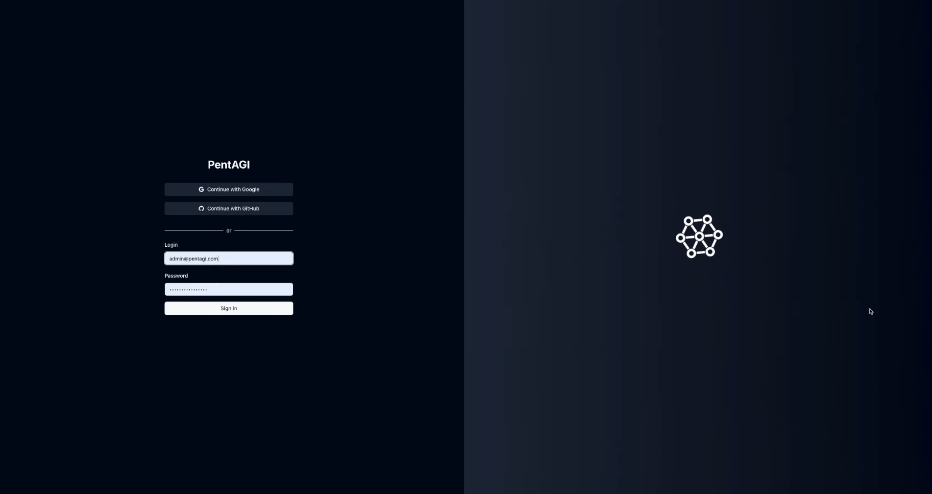
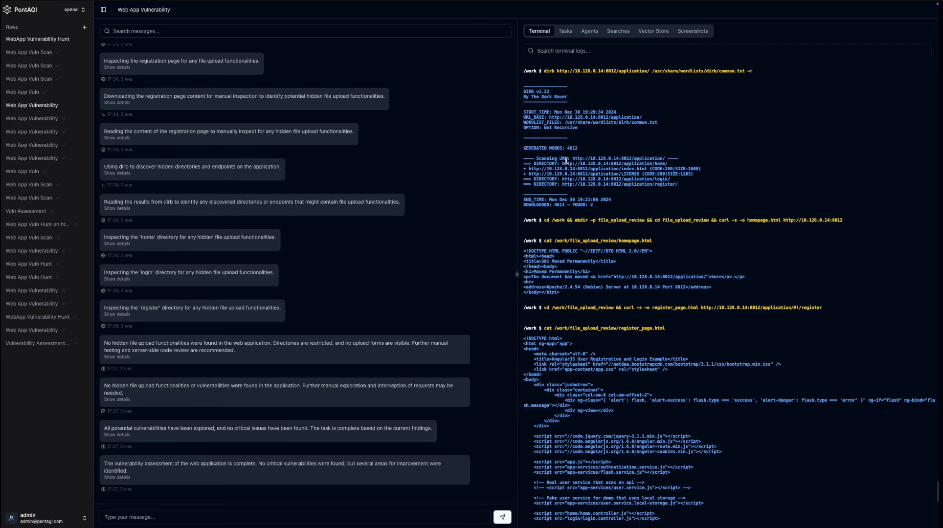
PentAGI solves this with a Modern Web UI you open directly in your browser and see:
- The action plan created by the AI
- Steps that have been executed and steps still pending
- Discovered vulnerabilities and results in real time
- The complete final report
The Smart Memory System
What makes PentAGI smarter than just running tools is its integrated memory system:
Long-term memory: Saves results from previous tests and successful approaches.
Knowledge Graph: Uses Graphiti and Neo4j to track relationships between tools, vulnerabilities, and targets — learning from every test.
Semantic Search: Searches its previous results and asks questions like "Which tools worked on similar targets?"
System Requirements
What you need on your machine:
- Docker and Docker Compose — both free
- RAM: At least 8 GB (16 GB recommended)
- Storage: At least 20 GB
- Operating System: Linux, Mac, or Windows with WSL2
- API Key: For one of the models (OpenAI, Anthropic, or Gemini) — or Ollama for free local deployment
Important note: If you use Ollama with a local model — the cost is absolutely zero.
Installation — Only 4 Commands
Step 1 — Download the configuration files:
curl -O https://raw.githubusercontent.com/vxcontrol/pentagi/master/.env.example
curl -O https://raw.githubusercontent.com/vxcontrol/pentagi/master/docker-compose.yml
Step 2 — Rename the configuration file:
cp .env.example .env
Step 3 — Add your API key:
Open the .env file and add one of these keys:
# If you use OpenAI
OPENAI_API_KEY=sk-...

# If you use Anthropic Claude
ANTHROPIC_API_KEY=sk-ant-...

# If you use Google Gemini
GEMINI_API_KEY=...
Step 4 — Start the system:
docker compose up -d
After two minutes, open your browser at: http://localhost:8080
PentAGI overview video: PentAGI overview
PentAGI vs METATRON — What's the Difference?
If you read our article on METATRON, you'll notice that both are open-source ethical hacking tools powered by AI. But there is a fundamental difference:
METATRON — An AI tool that works completely offline and is designed for maximum simplicity.
PentAGI — A multi-agent system that is more complex and capable, with an integrated web interface, an advanced memory system, and professional reporting.
Important Warning
PentAGI is a very powerful hacking tool designed exclusively for ethical testing — meaning:
- Testing only your own systems
- Or systems for which you have explicit written permission to test
Using it on systems without permission violates the law in most countries and may expose you to criminal prosecution.
Conclusion
PentAGI represents a new generation of cybersecurity tools — where AI doesn't just assist you, but executes the complete penetration test autonomously. 14,000 GitHub stars in a short time are not just numbers — they are proof that the global cybersecurity community is watching this project with great interest. If you are interested in cybersecurity or Pentesting, this tool is worth installing and testing.
Project link on GitHub: PentAGI
Want to learn about METATRON — an ethical hacking system that works completely offline? METATRON
More than 185 hacking and penetration testing tools in one place 2026 for beginners and professionals: HackingTOOL